Water and Wastewater Blog

Saturday, August 22, 2009

What's it worth to have that 'chemically treated' lawn?


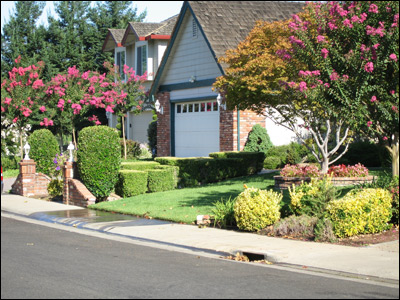
Who doesn't like a beautiful weed-free lawn in their front yard? We believe an attractive lawn earns us the approval of our neighbors. Dave Barry, the syndicated columnist said, “The average American home owner would rather live next to a pervert, heroin addict or communist pornographer than someone with an un kempt lawn.”

But the question is what is it worth to have that ‘chemically treated’ lawn or how large a price will we continue to pay for our manicured green carpets?

As Americans, we spend $40 billion per year caring for our turf and lawns- that’s ten times more than is spent on school textbooks! But it smells so good when it’s cut, it’s so pleasant to look at, it’s fun to roll and run on, it’s alive, it’s green and natural. Botanically speaking, a lawn is far from natural. Turf grass is a monoculture, developed to suppress, and out-compete all other species that would normally germinate in its place. If you choose to plant and maintain turf grass, you are essentially eliminating diversity in your home garden.

Well, I will keep the biological diversity issue for some later discussion but let’s focus on the nutrients and fertilizers that we have been applying to our lawns.

Did you know that :

The hazardous lawn chemicals are drifting into our homes where they contaminate indoor air and surfaces, exposing children at levels ten times higher than pre-application levels.

Of 30 commonly used lawn pesticides, 19 are linked with cancer or carcinogencity, 13 are linked with birth defects, 21 with reproductive effects, 26 with liver or kidney damage, 15 with neurotoxicity, and 11 with disruption of the endocrine (hormonal) system.

Of those same 30 lawn pesticides, 17 are detected in groundwater, 23 have the ability to leach into drinking water sources, 24 are toxic to fish and other aquatic organisms vital to our ecosystem, 11 are toxic to bees, and 16 are toxic to birds. With numbers like this, the only logical question becomes: is this really necessary and what can we do to stop or prevent this kind of contamination?

Some 100 million pounds of pesticides are used by homeowners in homes and gardens each year, even more when commercial companies are added in. Suburban lawns and gardens are known to receive far heavier pesticide applications per acre than most other land areas in the U.S., including agricultural areas.

As far as I remember, storm water run-off from non-point sources (such as farms, residential lawns) contribute to anywhere from 60 to 80% of the nutrient loading in our streams. How? It is as simple as rain falling on the chemically treated and overly fertilized lawn and running down the roadside gutter to the nearest creek. Big rain events result in major nutrient and chemical ‘shock’ to the urban creeks and streams and result is really worrisome.

The world is rapidly changing and with it are perspectives on the use of toxic lawn chemicals and the hazards they pose to our children, families, neighbors, wildlife, and drinking water sources?

I am NOT advocating against having a lawn or a green yard. Rather, they are important from preventing soil erosion. What I am advocating is putting a simple thought behind the ‘routine’ practices. Educate our selves and be more responsible about our actions for preserving our environment and be responsible for sustainable future for us and coming generations.

Resources are out there to help you out.

Mulching, planting native plants and shrubs, customizing the fertilizers per your soil / garden’s needs rather than blindly applying fertilizers, going ‘organic’ route for weed control and fertilizing are just a few simple ways to have environmentally friendly lawns.

In most cases, doing ‘the right thing’ is economical is the long run and may be even short run. Just give it a careful thought!

Good resources for additional information are:

Organiclawncare101 and Organic Lawn Care FAQ


Links to the resources from which I received information for this post:

http://cfpub.epa.gov/ncer_abstracts/index.cfm/fuseaction/display.abstractDetail/abstract/797

http://www.beyondpesticides.org/pesticidefreelawns/

http://www.ghorganics.com/Refuse%20to%20Use%20Lawn%20Chemicals.htm

http://www.losethelawn.com/lose_lawn_article.php

Below are some additional resources to go ‘organic’ and have sustainable and environmentally friendly yard!

Organic Lawn Care FAQ

http://www.ghorganics.com/products_currently_available.htm

http://www.ghlp.org/tips.html

http://www.richsoil.com/lawn-care.jsp

Additional Information on this subject can be found at:

http://www.mde.state.md.us/assets/document/AppendixE.pdf

http://www.extension.umn.edu/distribution/horticulture/DG2923.html

http://www.westchestergov.com/HEALTH/JustSayLawnChemicals.htm

http://www.yougrowgirl.com/lawns_gardens_convert.php


Friday, July 24, 2009

Let's have a debate....who is using that water?

So, I was on the flight back to Atlanta and started chatting with the person traveling next to me. His name was Jay and he was a project manager for a software consulting firm.
Somehow our discussion on 'consulting' turned to 'water issues' in general.
I was amazed how many very interesting topics we touched on....each one of them worthy of having a debate.

I am hoping to pose these questions and issues to the readers of this blog and I am inviting you to have a dialogue or at least express your opinion.

First on the list is - Who is using that water?

Jay mentioned to me that he recently moved to a community where he did not receive any water bill. Water and sewer charges were included as part of the HOA (Home Owners Association) fees.

At first, this sounds great.....no water bill! How wonderful...

Think about it for a moment and the picture becomes clear.

Although, there were no individual water meters on homes, the 75-home community had one common water meter and water bill was evenly distributed to all residents. Cost of the water and equivalent sewer bills were included as part of the HOA payment.

So, I asked him...
Does everyone in your community have a lush green yard?

The obvious answer was Yes. Beautiful lawns.

Second question, how many people do you have in your house and how about the next five houses on your street?
Jay said - we are two but our neighbors on both sides have three kids.

And sure enough....he got the gist of where I was going with these questions.

The point is....with such arrangements, people don't have any incentive to value water. Why would someone fix their leaky toilet at home? Fixing it might cost them close to $100 versus letting it run and the let everyone in the neighborhood pick up the tab for the water wastage.

What about an underground leak on the pipe within the neighborhood? No one would see if, no one would feel it (in form of water bill) - it will never get fixed.

Jay understood the issue very well and did make a note to bring this up in the next HOA meeting. Although, water is not a significant component of the HOA fees right now, it could and I would say....it would in a near future if the community continues to operate this way.

He has quiet a few uphill battles to fight still. Installing a water heater on every home is a significant upfront cost. In some cases, water utilities / providers will charge anywhere from $2,000 to $3,000 to tap the line and install a new water meter.

So, who would pay such upfront cost?

A lot of the water utilities (providers) have water conservation plans.
However, my hunch is the water utility may not want to play ball in this case.

Installing water meters on individual homes will eventually lead to lesser water consumption. Less water they sell, less money they make. Every utility is virtually hurting for revenues and unless they increase the water / sewer rates.....they can't make up for the deficit.

The other side of the question is - why would any utility (water provider) even allow such development?

Whose responsibility is it to promote 'water-wise' development? How do you think this issue can be resolved?


Back to the bigger issue here...

Atlanta has very limited resources and water being the number one in my list. We are paying far too less for water to be thinking about it and preserving it. Drought of last three years had brought much needed attention to the value of water but......we are back to the 'same - old - habits' after the good rain in the spring this year.

Sunday, June 14, 2009

Real Water Heroes - Ms. Young Engineer in Training

H2Opportunity program started a campaign to bring the REAL WATER HEROES in the lime light! With the official roll out of the H2Opportunity program in Fall 2008, animations paying tributes to 'real water heroes' were created.

A tribute to the 'Miss Young Engineer in Training' - one of the real water heroes - is posted here.
Enjoy!


More 'Real Water Heroes' videos will be posted soon, so stay tuned and come back and visit us.

Monday, March 23, 2009

Surviving the Economic Drought


GAWP is planning to host a special student networking event at the Spring Conference in Macon, GA. This event is hosted as part of the H2Opportunity program and themed as 'Surviving the Economic Drought'

During this special session we will discuss the outlook for the water industry, the future of a career in the water profession and provide an opportunity for students to network with professionals. Session is planned for Tuesday, April 14th from 1:00 – 2:30 pm

Industry experts from all segments (consulting, utilities, academia, etc) will be present at this session. Students and Young Professionals will be able to ask direct questions and get career guidance.


The fee for students is $ 25 and will include: Tuesday registration at the Spring conference, lunch, etc. See the attached flyer. Students are also encouraged to bring their resume along to get posted on the bulletin board as well as on the H2Opportunity website.


Monday, February 2, 2009

GAWP Scholarships and you!

With current state of economy and market conditions, a lot more people are going back to school to get further educations and students are taking longer to graduate. School enrollments are approaching new highs. However, with dwindling funds, the school endowments are also dropping fast. Research grants have been cut back and a very few students are getting assistantships or funding.

In such tough times, students' should seek various innovative ways to get the funding for their education.
One such way is to get a 'scholarship'. Some of the scholarships may not be significant in amount, but in a tough economic drought, every drop counts!

GAWP offers a variety of scholarships to full time students. A list of available scholarships is provided below:

• GAWP’s Undergraduate Scholarship

• GAWP’s Frontline Undergraduate Scholarship

• GAWP’s Graduate Scholarship

• GAWP’s H2Opportunity Undergraduate Scholarship

• William J. Green Hr. Scholarship Fund

• Philip R. Karr, III Scholarship Fund

•Scholarships from Gerogia Section of AWWA (two).


A lot of these scholarships have potential for continuation/extension for a second year.

For scholarship information and eligibility criteria

http://www.gawp.org/pdf/EligibilityRequirements-Scholarships2009.pdf

For Scholarship application forms

http://www.gawp.org/pdf/Application-Scholarships2009.pdf

Deadline for submitting applications is February 28th 2009.

So, act soon and take your best shot!!
Good luck!

Wednesday, January 21, 2009

U.S. Stockholm Junior Water Prize


The International Stockholm Junior Water Prize is world's most prestigious youth award for a water-related science project. The prize taps into the unlimited potential of today's high school students as they seek to address current and future water challenges.

The international Stockholm Junior Water Prize competition brings together the world’s brightest young scientists to encourage their continued interest in water and the environment. Each year, thousands of participants in over 30 countries join national competitions for the chance to represent their nation at the international final held during the World Water Week in Stockholm. During their time in Stockholm, winners of the national competitions receive an opportunity to meet and learn from the present leaders of the global water community and make life-long friendships with international compatriots who share a passion for water and science.

The national and international competitions are open to young people between the age of 15 and 20 who have conducted water-related projects focusing on local, regional, national or global topics of environmental, scientific, social or technological importance. The international winner receives a USD 5,000 award and a crystal sculpture. As a result of the competitions, thousands of young people around the world become interested in water.

Last year, Joyce Chai of United States went on to win the US as well as International Stockholm Junior Prize. More information on her winning research can be found at

Link


If Joyce can, then so can you and kids around you!


For more information, be sure to check out these links:
Stockholm International Water Institute

Stockholm Junior Water Prize

(anup)

WaterPartners News